





Research led by a University of Virginia medical student has found a routine health check can flag dangerous high blood pressure in patients who often think they have it under control.
Although the study was small, its findings were so foundational that the Journal of the American Medical Association published them in its ophthalmology edition in June. The lead author of the study is Sai Samayamanthula, a fourth-year medical student in the School of Medicine.
Researchers performed blood-pressure checks on 172 adults with Type 1 or Type 2 diabetes during routine retina clinic visits – not a standard screening, despite a known link between high blood pressure and the progression of diabetic eye disease – to see whether eye appointments could also help identify patients with dangerously high blood pressure. Here is what they found:
People are also reading…
- Fewer than 1 in 10 patients had normal blood pressure.
- More than half met the criteria for Stage 2 hypertension.
- About 10% had blood pressure readings high enough to be considered a hypertensive crisis.
- Many participants who were unaware they had high blood pressure were found to have elevated readings.
- Many patients were advised to follow up with their primary care physician, and some required urgent medical evaluation.
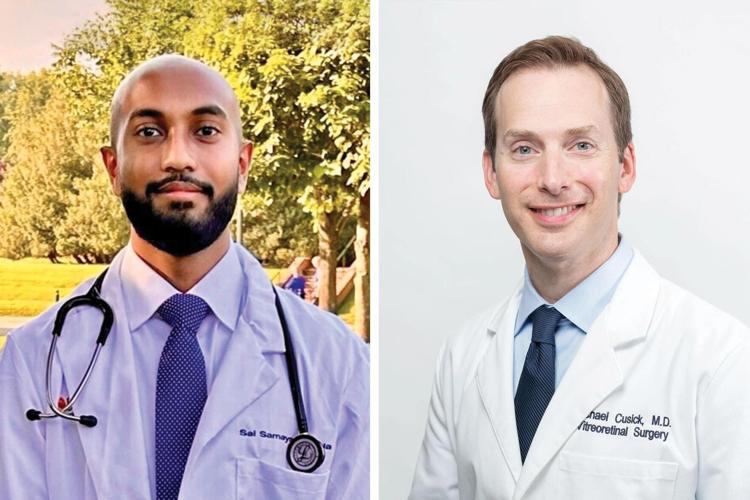
Sai Samayamanthula is a fourth-year medical student at UVA and the first author of the study, just published in the Journal of the American Medical Association Ophthalmology. His mentor is Dr. Michael Cusick, who has been at UVA for 16 years.
Samayamanthula and retina specialist Dr. Michael Cusick, his mentor on the project, explain why a routine blood pressure check during an eye appointment could make a difference for patients.
What prompted this research?
Cusick: I have been a retina specialist for about 16 years, and one of the most common conditions that we treat is diabetic eye disease. We know that controlling blood pressure helps slow down diabetic eye disease, so we wanted to integrate blood pressure screening into our eye clinics. We know high blood pressure causes problems. We know controlling it helps slow down eye disease, and we wanted to play a role in that.
Did the findings surprise you?
Cusick: The magnitude was surprising. A significant number of patients were already under the care of a provider and thought they were doing well. It is one thing to have patients say, “I don’t think I’m doing well. Thanks for checking it.” It is another thing to have patients say, “I think I’m doing fine,” and then we check it, and it is really out of control.
Why might blood pressure still be high for patients on medication?
Cusick: There are many reasons. They may not be treated as aggressively as they need to be. They may not be taking their medication as prescribed. Sometimes there is a misunderstanding about how or when to take it. Sometimes they cannot afford their medication. There are a lot of reasons why that gap exists.
Why do these findings matter?
Cusick: This is a modifiable risk factor. It is something we can do something about, and the earlier you intervene, the more you can save vision. It can also prevent significant eye complications that require injections, lasers or surgery. Beyond the eye, it can help prevent heart attacks, strokes and kidney disease.
What do you hope happens because of this research?
Cusick: We are trying to help the ophthalmology clinic contribute more to the monitoring of patients, instead of simply dealing with the downstream consequences. Specialty clinics in integrated healthcare systems can serve as additional sites for surveillance of systemic conditions like high blood pressure.


