


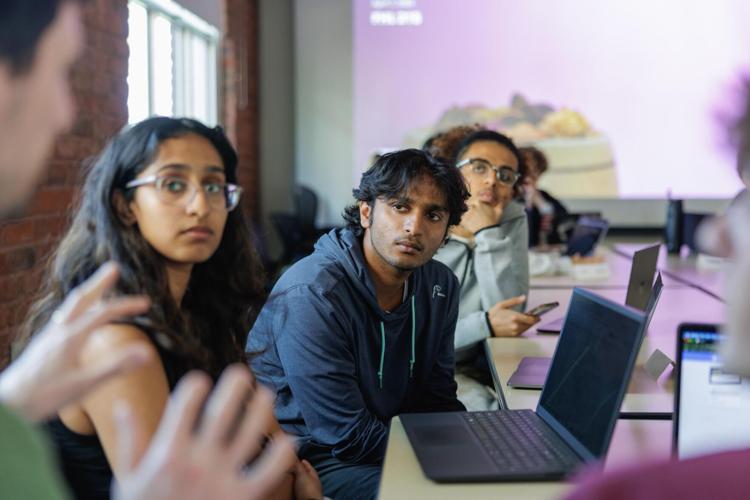
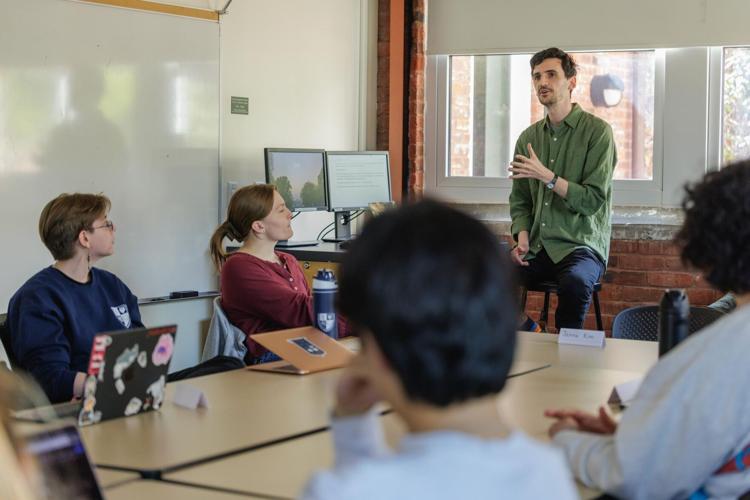
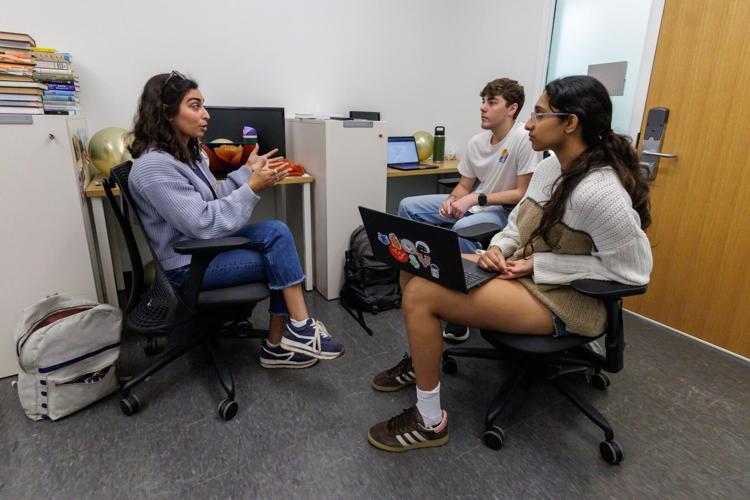

This spring, a group of University of Virginia students chose to try something new, an audio storytelling class that challenged them to explore humor in unexpected ways.
In assistant professor of English Piers Gelly’s Writing with Sound course, students spend the semester talking about podcasts and audio storytelling as a distinct art form, as well as practicing the crafts of interviewing, writing for the ear and editing. Then, for their final project, all 15 students brainstorm one main topic and break into smaller groups to research and record a podcast episode on their selected idea.
Previously, Gelly’s students have produced final projects documenting 24 continuous hours on the Lawn and exploring the popular campus dating experiment known as the Marriage Pact. This semester, Gelly’s class chose to explore the concept of humor.
People are also reading…
Third-year students Harshika Challa, Sankalp Yadava and Nader Bashammakh, along with fourth-year student Carter Fortune, enrolled in Gelly’s course and spent the final month of the spring semester working on the project as a group.
“Humor was written on the board, and there were 20 different arrows coming out of the word. We ended up picking four subtopics to explore,” Fortune said.
The group chose to focus their segment of the podcast on the psychology of laughter.
“We all had our individual ideas about what we wanted to do in class. Humor was one, but we also talked about different types of anger, finding yourself in college and other things. Humor was picked because the whole class thought it would be interesting,” Fortune said.
Fortune was enrolled in a social psychology course during the fall semester, during which he realized his professor, Adrienne Wood, led the Emotion and Behavior Lab at UVA. Challa also knew someone who could help at the lab.
In partnership with Sareena Chadha, a doctoral candidate in social psychology working at the lab, the group opted to study “co-laughter,” the act of multiple people laughing together, to better understand laughter as a social cue and to explore how something like laughter could be measured in a lab setting.
“I think that the psychology of laughter is the root cause of humor. People find different things funny for different reasons,” Yadava said. The group discussed why children find certain topics funny, the nature of inside jokes and who decides what makes something funny.
“I’m not a very creative person,” Bashammakh said. “I’m a biology major, so most of the classes I take are really science-based, but this one was interesting.”


